“AI agent” gets thrown around so loosely now that it’s lost most of its meaning. Every software company slapped it on their product in 2024. So here’s the actual, practical difference — no hype, just what each one does when a customer interacts with it.
A chatbot answers. An agent acts.
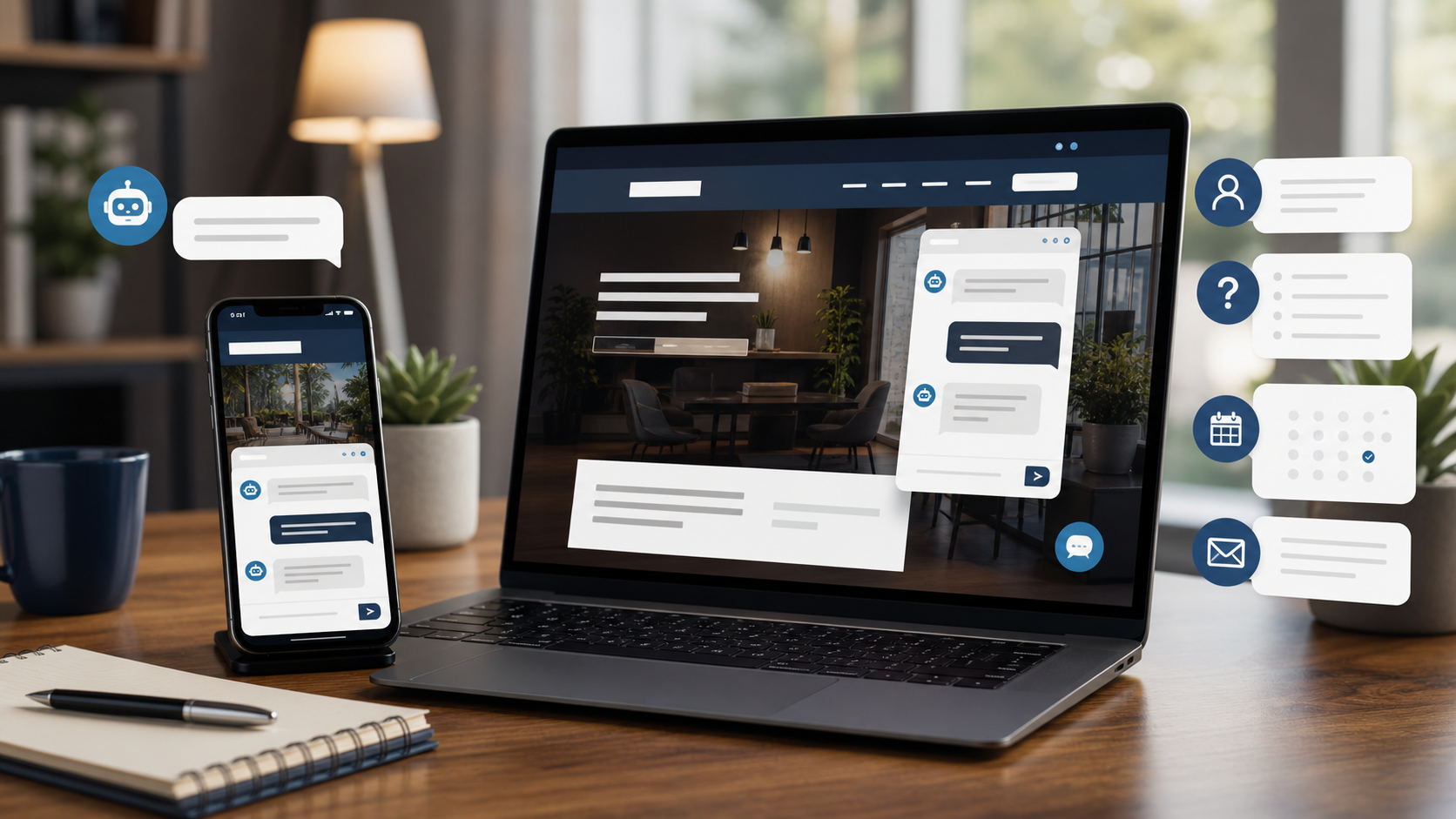
A chatbot is a conversation tool. You type a question, it matches your words to a script or a knowledge base, and it replies. Even the AI-powered ones (built on GPT-style models) are still fundamentally doing one job: generating the next sentence in a conversation. It can tell a customer your hours, explain your return policy, or recommend a product from a list you gave it.
What a chatbot cannot do is finish a task. If a customer says “reschedule my Tuesday appointment to Thursday at 2pm,” a standard chatbot will say something like “I can help with that — please call us to confirm” or, worse, it’ll confidently say “Done!” and nothing actually happened in your calendar.
An AI agent is built to close that gap. It’s connected to your actual systems — your booking calendar, your CRM, your inventory, your payment processor — and it takes real action inside them. The same rescheduling request, handled by an agent, results in the calendar entry actually moving, a confirmation text going out, and the old slot opening back up for someone else to book. No human touched it.
The technical difference, in plain terms
A chatbot works off a decision tree or a single AI call: input comes in, output goes out. An agent works in a loop: it receives a request, decides what steps are needed, calls outside tools or APIs to complete those steps, checks whether the result is correct, and only then responds to the person. That loop — plan, act, check, respond — is the whole definition. If a system can’t do that loop, it’s not an agent, regardless of what the sales page calls it.
This is why agents need to be connected to something. A chatbot can run standalone with just a script. An agent needs access to your scheduling software, your database, your payment system, or whatever it’s supposed to act on. That connection work is most of what separates a $50/month chatbot widget from a properly built AI agent — it’s integration work, not just conversation design.
Where this shows up in real businesses
Take a call center scenario. A chatbot on your website can tell a visitor your business hours and services. An AI receptionist — which is an agent — can answer the phone, check real-time availability in your booking system, quote an accurate price based on the service requested, book the appointment, and send a confirmation, all inside one phone call. We cover exactly how that call flow works in a separate post, but the short version: the difference is whether the calendar actually updates or whether a human still has to do that part afterward.
Same logic applies to a business assistant. A chatbot can answer “what’s my refund policy” all day. An agent can pull a specific customer’s order from your system, check if it qualifies for a refund under your actual rules, process the refund, and log the interaction — without a person approving each step.
Where agents still fail
Agents aren’t magic, and pretending otherwise sets people up for a bad experience. They fail in specific, predictable ways:
- Ambiguous requests. If a customer says “the usual” and your system has no order history connected, the agent has nothing to act on.
- Bad integrations. If your calendar software doesn’t expose an API, no agent can book into it reliably — it’ll either fail silently or fall back to “someone will call you.”
- Edge cases outside its permissions. A well-built agent should hand off to a human when the request falls outside what it’s authorized to do — refunds over a certain amount, legal questions, complaints. An agent that tries to handle everything itself is a liability, not a feature.
A good agent build defines those boundaries up front: what it can do autonomously, what it escalates, and what it flatly refuses to guess at.
Which one your business actually needs
If your goal is just to answer common questions and reduce a few emails — a chatbot is enough, and it’s cheaper and faster to set up. If your goal is to stop losing bookings after hours, stop double-entering data between systems, or handle repetitive customer requests start to finish without a person in the loop — you need an agent, because that requires actual system access and action-taking, not just better answers.
The question to ask before buying either one: “After this tool responds, does something still need to happen?” If yes, you need an agent. If the answer itself is the whole job, a chatbot will do.
For a deeper look at what a chatbot specifically does day-to-day for a small business — and where its limits show up in practice — see What an AI Chatbot Actually Does for a Small Business.